

The spread of remote work received a significant boost in Hungary during the COVID-19 pandemic. Although its prevalence declined once the pandemic passed, over the past two to three years the use of home office has stabilised at a level much higher than before. In September 2025, according to the results of a representative GKI survey, 29% of employees in Hungary have the opportunity to work from home. A key trend in the near future may be a gradual return to the office, but working from home will not disappear entirely.
For a long time, working from home was accessible only to those in a few privileged occupations, but the spread of broadband internet has significantly broadened the range of tasks that can be performed remotely. The COVID-19 pandemic accelerated the spread of remote work worldwide, including in Hungary. According to data from the Hungarian Central Statistical Office (KSH), the number of people working from home regularly or occasionally clearly increased during the first two waves of the pandemic. The peak came during the first wave, when the number of remote workers reached 700,000, compared to 110,000 at the end of 2019. At the peak of the second wave, 600,000 people were affected. Between 2022 and 2024, this number ranged between 300,000 and 400,000.
Typically, how many days per week do you work from home (in a home office)?
(percentage)
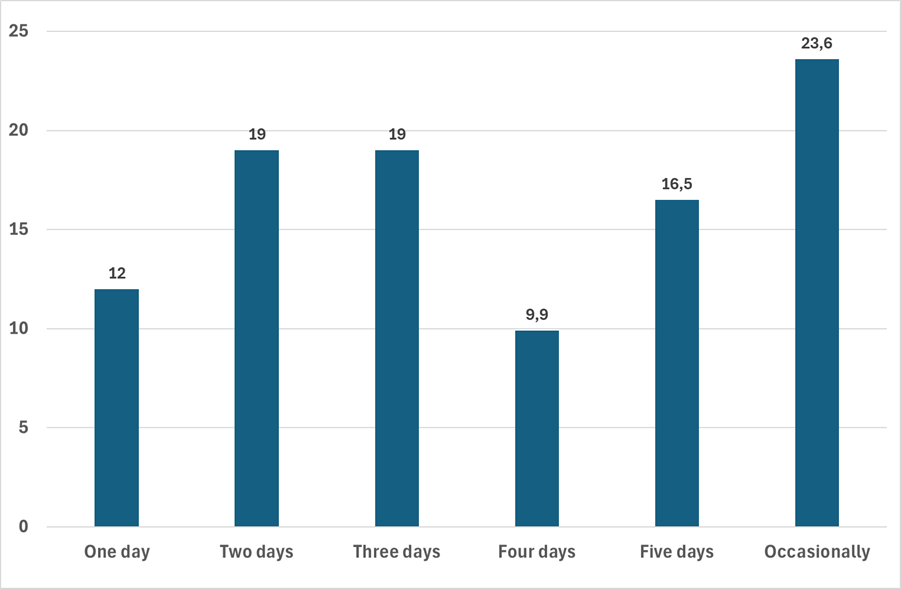
Source: GKI’s survey
The share of those working from home regularly or occasionally in Hungary is somewhat smaller than in the Czech Republic, Poland or Slovakia, but nearly twice as high as in Bulgaria or Romania. In 2024, the Hungarian data represented roughly half the EU average. The frontrunners in Europe are the Dutch, where a little more than half of employees can work from home at least occasionally. Danish, finnish, luxembourgish and swedish employees can also take advantage of remote work in nearly half of cases. In these countries, the service sector accounts for a large share of total employment.
In Hungary, a slight downward trend in the prevalence of remote work has been observed so far in 2025. Primarily public service institutions, but also large corporations in the business sector, increasingly wish to strengthen the role of office-based work. Good examples of this are that this year both the MÁV–Volán Group and MOL have abolished the option of working from home.
GKI conducted a survey of 1,000 adults representing the Hungarian population to examine the domestic prevalence of remote work. Among employed respondents, 29% have the opportunity to work (also) from home. Every second person with higher education has this possibility, while among those with secondary education only one in five does. In independent professional occupations, the occurrence of remote work exceeds 80%, and more than half of senior executives and self-employed entrepreneurs are also affected.
A notable difference has developed between the private and public sectors. While in the private sector 71% of graduate subordinates and 43% of office employees can work from home at least occasionally, in the public sector these ratios are 10% and 16%, respectively. In the Central Hungarian region, remote work covers almost half of employees (44%), and its prevalence is also above average in Central Transdanubia (37%). In other regions of the country, the proportion is around 20%. The frequency of home office rises more or less in parallel with income: among those earning up to HUF 200,000 net per month, employees working remotely are rare, while among those earning over HUF 700,000, the share of home office users is around 60%. Working from home is especially popular among employees aged up to 29, nearly half of whom are involved – this age group has the strongest demand for flexibility between work and free time. Among the middle-aged, one in four employees also works remotely. One-third of employees in their fifties, and only one-fifth of those over sixty, work from home.
Every fourth person who works (also) remotely uses home office only occasionally, while three-quarters can apply it regularly. Among those working (also) from home, one in six never goes into the workplace; the rest are employed in a hybrid form. Of those who work exclusively from home, 80% are women and 20% are men. Full remote work is much more common among those with higher education than among people with secondary qualifications.
Number of remote workers in Hungary (thousand people), 2019–2025
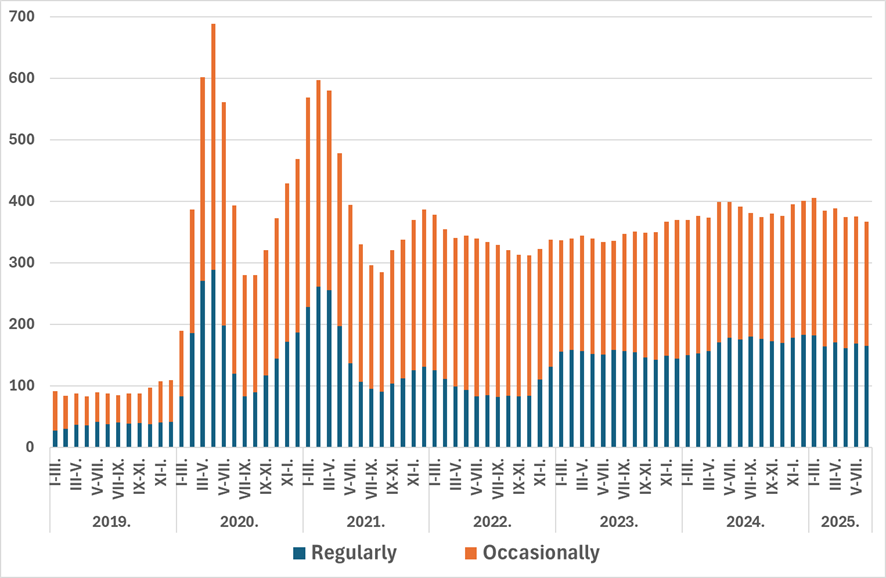
Source: KSH
Among multinational corporations, international service centres, banks and the IT sector, hybrid models are generally more common due to international practice and the need to retain talent. Among smaller domestic firms there is considerable variation – some allow flexibility to save on costs (office space, utilities), while others place greater emphasis on supervision and insist on full-time office presence.
A defining trend in the near future may be a gradual return to the office, but the role of home-based work will not disappear. In Hungary, over the next two to three years the key question will not be whether home office remains, but in what form. The public and conservative sectors are expected to scale it back, while multinationals and knowledge-based companies will retain it. The likely compromise is a hybrid model with one or two days of home office per week. Due to younger generations’ demand for flexibility, a total ban on remote work would be unsustainable in the long run. Many companies are expected to tighten their home office policies, but employee demand for it will remain strong. Employers that eliminate home office entirely take significant risks: they may face higher turnover, recruitment difficulties and lower employee satisfaction. In the future, the role of the office itself may also change: it may not necessarily serve as a permanent working environment but rather as a space for community and collaboration. Economic and technological changes will also play a role: if infrastructure continues to develop (through digitalisation and AI tools that support home office), the potential for remote and flexible work could expand further. At the same time, office culture is likely to regain some ground, which has several advantages: strategic meetings, creative work, brainstorming, team building and the experience of belonging to a community. According to GKI’s forecast, the number of workplaces in Hungary offering the option of remote work may slightly decrease over the next two to three years, but the hybrid model is not expected to decline significantly.