

According to a GKI survey, 27% of companies provide the option of working from home to at least some of their employees. Home office has thus become a stable but highly segmented form of employment in Hungary. The prevalence of working from home is outstanding in the service sector and is almost not characteristic of the construction industry at all. Large companies are the most inclined to use this form of employment, with 83% of them applying remote work. In the next one to two years, three quarters of businesses do not intend to change their related practices.
Regular work from home was previously available only to a few types of professions. These included employees in IT and technology roles, those engaged in creative and intellectual freelance work, consultants and analysts, private tutors, as well as those involved in administrative support tasks (data entry, accounting, etc.).
The Covid-19 pandemic has thoroughly reshaped the landscape of remote work in Hungary.
The spread of broadband internet has expanded the range of tasks that can be performed remotely, and the coronavirus pandemic made the use of remote work necessary for employers as well. Essentially, employees were sent to work from home wherever possible. The pandemic did not invent remote work but massified and normalized what had previously existed only in a narrow circle. As the pandemic subsided, the role of working from home decreased, but hybrid models remain present: the number of employees in Hungary working partly from home and partly in the office is currently much higher than before the pandemic. According to data from the KSH labor force survey, after the pandemic, 8–10% of employees worked partly or entirely from home, compared to 3–4% before 2020. The latest statistical data shows that between August and October 2025, around 392,000 Hungarian employees performed remote work occasionally or regularly. This represented about 9% of the total employed workforce.
Just over a quarter of Hungarian companies provide the option of working from home.
In order to map the prevalence of remote work in Hungary and the future of this form of employment, GKI conducted a survey in the Hungarian business sector in December 2025. Those engaged in agriculture and public services were excluded from the survey. Nearly 1,500 business organizations provided evaluable responses. Among the responding companies, 27% offer the option of working from home to at least some of their employees. On average, this option applies to roughly half of the employees in these companies. Considering the total workforce employed by all respondents as 100%, 13% of employees—essentially every eighth worker—perform some tasks from home occasionally or regularly. Since the sectors excluded from the survey likely have a much lower incidence of home office, the sample analyzed by GKI can be considered representative in this regard.
Would you work from home (too)? If you were at a large company.
The proportion of companies offering the option of working from home to at least some of their employees is average (27%) among micro-enterprises with fewer than 10 employees. However, in larger companies, a clear correlation between company size and the frequency of remote work can be observed: as the number of employees increases, working from home becomes more common. An overwhelming majority (83%) of companies employing more than 250 people also use remote workers. At the same time, micro-enterprises are the only group where, if a company offers remote work, the majority of employees (two-thirds) can take advantage of it. In small, medium, and large companies, this option applies to only one-third to one-fifth of employees. Considering the entire corporate base, it can be noted that 17% of employees in micro-companies, 13% of employees in companies with 150–250 staff, and 21% of employees in large companies with more than 250 staff work from home at least occasionally. In other employee size groups, this proportion is below 10%.
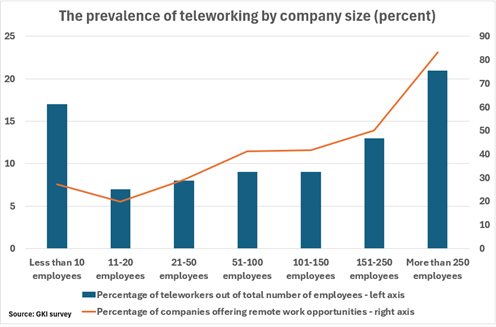
The powerhouse of home office is the service sector.
Due to the nature of their activities, it is not surprising that work from home is less common in the production sectors: among construction companies, one in nine, and among industrial enterprises, one in five provide this option to their employees. The trade sector roughly matches the national average, with one in four companies offering remote work. Home office is most popular among business service providers, more than half of which (55%) allow working from home.
The production sectors fall short of the average not only in the proportion of companies offering remote work but also in the share of employees who can take advantage of this option. Construction companies that offer remote work provide it to 30% of their employees—this represents only 3% of the total workforce in the sector. In industry, these two ratios are 40% and 9%, respectively. In trade, the option applies to 45% of employees in companies offering remote work, while in the service sector, it applies to 68%. Thus, 11% of all employees in trade and 37% of those in services are affected.
Within business services, the share of remote workers among all employees is particularly high in the IT sector (73%), legal and accounting services (60%), technical testing and design (56%), and research and development (50%).
No fundamental reorganization is expected in the next one to two years.
An overwhelming majority (76%) of companies that also employ remote workers do not plan to change their home office rules in the near future, while 5% of respondents plan to tighten remote work and 4% expect to allow it more flexibly; 15% were unable to answer. Among micro-enterprises and companies with 101–250 employees, the proportion of those expecting an increase or decrease in the significance of remote work is equal, whereas in companies with 10–100 employees, those anticipating stricter rules are in the majority. In contrast, in the large corporate sector, further expansion of home office is more likely. Among individual sectors, construction stands out, where a reduction in remote work opportunities may be the dominant trend, while in other sectors there is no significant difference between those expecting an increase or decrease in the role of remote work.