
According to GKI’s January 2026 household survey, 6% of respondents will definitely and 18% will probably spend a larger amount on their residential property over the next year. Over the past three years, households’ home renovation and modernization intentions have shown only slight fluctuations, with no clear trend. Since the closure of the Home Renovation Program, a significant share of people has moved into a wait-and-see position, presumably expecting the emergence of new, broadly accessible support schemes. Construction industry players would also consider these important.
| 6%
will definitely renovate |
18%
will probably renovate |
3 év
stagnation |
195k
apartment 2021–22 |
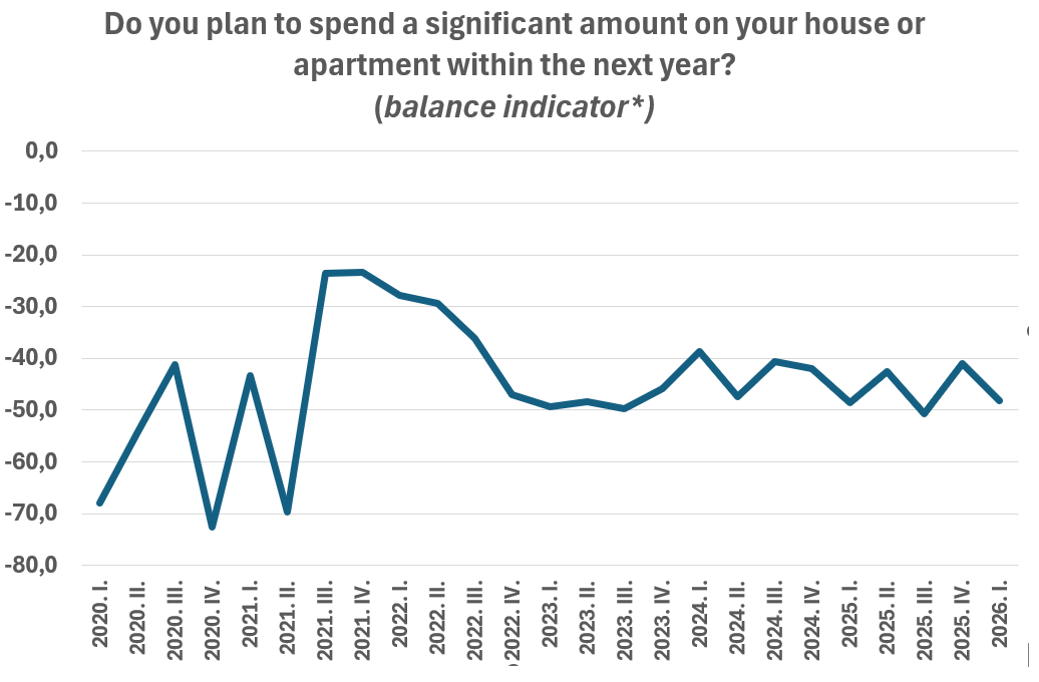
Source: GKI surveys.
*/ The balance indicator is the difference between the proportion of those planning home renovations and those not planning them.
A significant portion of Hungary’s housing stock is aging: 41% was built before 1970, and 42% between 1970 and 2000. Only 17% of the apartments were handed over in the 21st century. Older residential properties generally show considerable need for upgrades in terms of comfort, modernity, and especially energy efficiency. It is estimated that at least half of the domestic housing stock, which consists of 4.5 million residential units, falls into an FF or worse energy efficiency rating.
| Construction period | Proportion | Estimated units |
| Before 1970 | 41% | ~1,85M |
| 1970-2000 | 42% | ~1,89M |
| After 2000 | 17% | ~0,77M |
Over the past twenty years, various state subsidies have supported home renovations
The panel renovation program started in 2005, primarily for façade insulation and window replacements. The Green Investment Scheme began in 2009, funded from EU carbon quota revenues. In 2015, the introduction of CSOK brought a systemic change. The next significant step was the launch of the Home Renovation Program in 2021: up to HUF 3 million in state support, with matching own funds. The program ran for two years, during which a total of 195,000 apartments were renovated with its help.
| KEY TO THE SUCCESS OF THE HOME RENOVATION PROGRAM (2021–2022): |
| Simple structure • Broad eligibility • Flexible usability → 195,000 apartments |
Currently, several types of support are available.
The July 2022 amendment to the utility cost reduction created a new situation. At the beginning of 2026, multiple sources are accessible: the KEHOP Plus Home Renovation Program (up to HUF 10 million, only for energy-related purposes), the Rural Home Renovation Program, and the Rural CSOK (only in settlements with fewer than 5,000 residents). In the case of KEHOP Plus, more than 2 million homes are eligible, but by the end of 2025, only about 9,000 applications had been submitted.
| KEHOP PLUS: LOW UTILIZATION |
| 2 million eligible homes → 9,000 applications = 0.45% utilization |
Households’ home renovation intentions have essentially been stagnant for three years.
According to GKI’s January 2026 survey, 6% would definitely and 18% would probably renovate. These shares are the same as one year ago but lower than in October 2025 (8% and 22%). The marked boost observed at the launch of the 2021 Home Renovation Program did not repeat; households are showing more restrained interest. Over the past three years, intentions have not changed significantly either upward or downward.
Renovations are more likely among younger people and residents of villages.
Income clearly correlates with renovation intentions: lowest fifth 10% (3+7), highest fifth 49% (15+34). By age: 30–39-year-olds are the most active (35%), 60+ the least. By settlement type: villages (29%), small towns (26%). By region: Western Transdanubia stands out (28%).
| Dimension | Most Active | Least Active |
| Income | Top fifth: 49% | Bottom fifth: 10% |
| Age | 30–39 years: 35% | 60+ years |
| Settlement | Village: 29% | Large city |
| Region | Western Transdanubia: 28% | – |
EUROPEAN CONTEXT: RENOVATION WAVE AND REGIONAL COMPARISON
The EU Renovation Wave strategy (2020): double the building renovation rate by 2030 (from ~1% to ~2%). Hungary’s current rate is estimated at 0.3–0.5%, which is below the EU average.
| Country | Renovation Rate | Main Program |
| Poland | ~1.2% | Czyste Powietrze (700k+ houses) |
| Czech Republic | ~1.0% | Nová Zelená Úsporám |
| Hungary | ~0.3–0.5% | KEHOP Plus (low) |
| EU Target (2030) | 2.0% | Renovation Wave |
Summary
According to GKI’s January 2026 household survey, home renovation intentions have been stagnant for the third year, while the technical and energy-related renewal needs of the housing stock remain significant. Access to programs (eligibility, own contribution, administration) combined with investment uncertainties is holding back decisions, so any revival of the renovation market continues to be strongly driven by subsidies and financing. The current mix of support is targeted but not universal; this may explain why uptake is moderate compared to the potentially affected population. The key question for the coming period is whether widely accessible, simple, and predictable schemes will emerge that can activate households on a large scale, especially in terms of energy efficiency upgrades.