Based on KSH data, GKI examined the structure of Hungarian health care expenditures, which provides an important picture of the extent to which the system relies on public resources, and of the role played by household financing and voluntary health insurance financing within the system.
For most health care subsystems, public expenditure constitutes the main pillar of financing. In 2023, the state covered 93% of long-term care services, 94.7% of curative and rehabilitative inpatient and day-care services, 87% of clinical laboratory, diagnostic, and patient transport services, and 75.3% of the total cost of the prevention subsystem. This indicates that the most severe services requiring long-term, sustained treatment are accessible to the population through public funding, which is not surprising, as these services are rarely provided by private health care providers.
Financing forms of health care subsystems in 2023
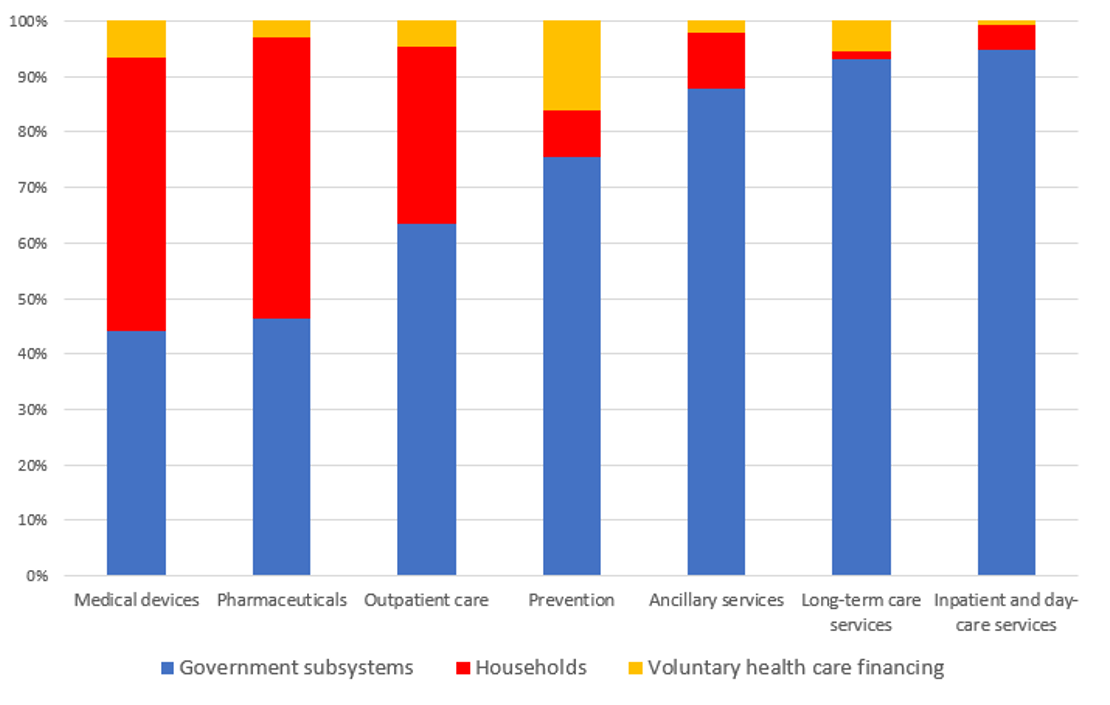
In other subsystems, however, the direct involvement of households is significantly higher. A substantial share of expenditures on pharmaceuticals and medical devices is covered by the population from their own resources, representing a significant portion of household spending. Household participation is similarly high in outpatient care, where public contribution is low, and patients therefore often pay directly for services. The population mainly uses these services through the private health care system.
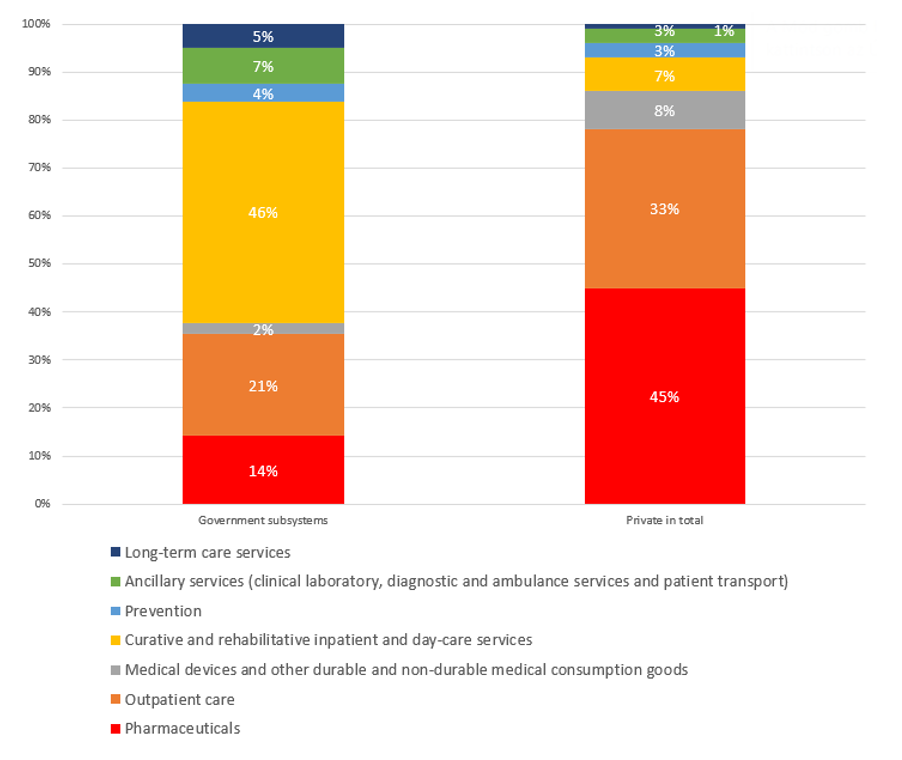
Nearly half of household private health care expenditures are accounted for by pharmaceuticals and medical devices. This is three times the share of public pharmaceutical expenditures. One third of private spending is allocated to outpatient care, which is higher than the share of public expenditures (21%). The proportion of spending on prevention in Hungary is low, even though such expenditures could reduce the need for later, more costly health care services in the long term.
The distribution of government and private health expenditures by health care subsystems in 2023
Source: KSH
In 2023, an average Hungarian household spent, in addition to public contributions (taxes and social security contributions), an average of HUF 272,000 on direct health care expenditures. The largest portion of this was spent on pharmaceuticals and medical devices (HUF 152,000), while households spent an average of HUF 89,000 annually on outpatient care.
Total health care expenditures per capita reached HUF 503,000 in 2023, of which HUF 371,000 was covered by the state budget. Based on this, the share of public financing was 73.7%, compared to 68.7% in 2019. The increasing share of public funding is mainly attributable to additional expenditures related to salary increases for health care workers.
Overall, the structure of Hungarian health care expenditures presents a dual picture: the state dominates in severe, long-term care services, while households bear a significant direct financial burden in pharmaceuticals, medical devices, and outpatient care.