

According to the newly published HCSO data, the consumer price index in March exceeded the previous year by 1.8 percent, while it increased by 0.4% compared to February. Therefore, the rate of price increase has accelerated slightly compared to the February year-on-year data.
the Iran conflict and the closure of the Strait of Hormuz Energy price shock and uncertainty were already partly incorporated into fuel prices in March . Compared to the previous year (when gasoline was 604 forints/liter), the price of vehicle fuels decreased slightly, due to the base effect, however, increased by 4.6% compared to February. The larger impact of the energy price shock was mitigated by the introduced protected prices.
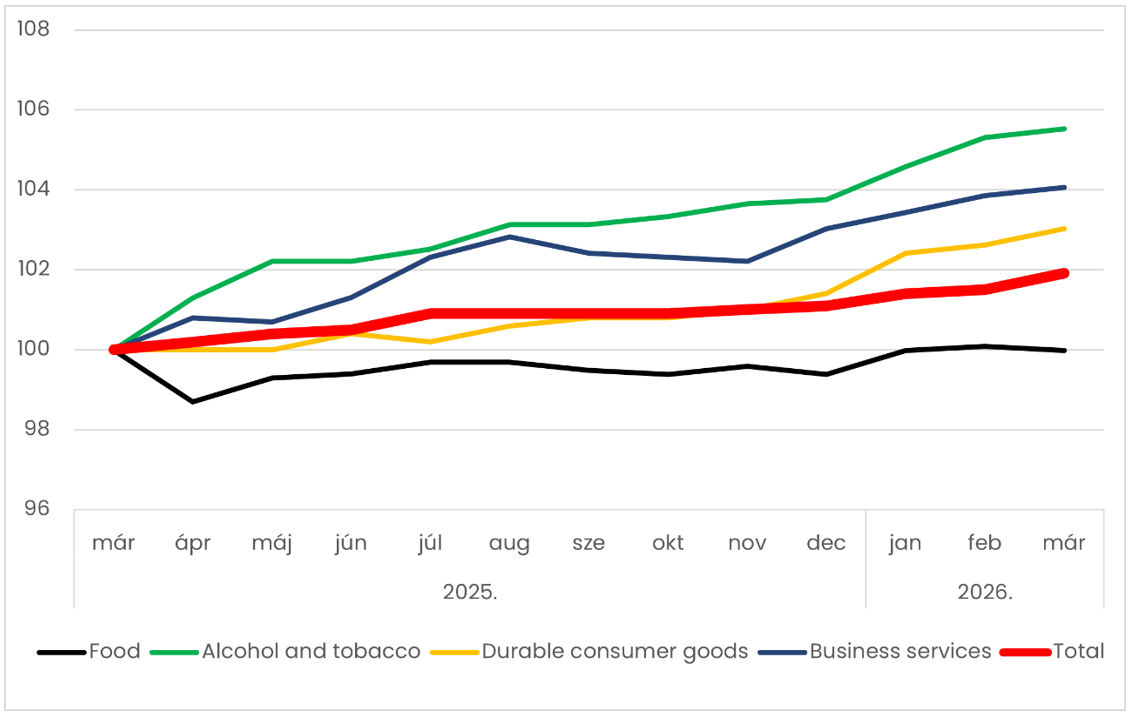
Development of the main components of the consumer price index, March 2025 = 100%
Source: Hungarian Central Statistical Office
The stagnation of food prices, and within this the decrease in the prices of processed and unprocessed foods, shows that the margin freeze and the annual strengthening of the forint also curbed the price increase. In the case of alcoholic beverages and tobacco products, the above-average price increase was caused by the increase in taxes. Clothing items showed high volatility over the past year (this segment is also characterized by seasonality), but overall the rate of price increase was slower than that of the overall price index. Services and consumer durables, on the other hand, increased by 4.1 and 2.7 percent annually. In the case of the latter, the longer-term strengthening of the forint moderated the increase, while the increase in the costs of domestic enterprises and the possible cross-pricing resulting from the margin freeze increased prices.
The overall slightly rising, but still low, inflation rate was due to several factors. The stronger forint in year-on-year comparison (it appreciated by 5.2% against the euro) and the decline in household inflation expectations (the latter was also confirmed by the GKI’s March business survey) contributed to the decline in inflation. While the increase in energy prices and the consistently higher price index of services caused the inflation rate to increase.