
In this series of articles by GKI Economic Research Co., we present the short- and long-term economic challenges facing the new Hungarian government. In the third part of our series, we deal with the wage level in Hungary.
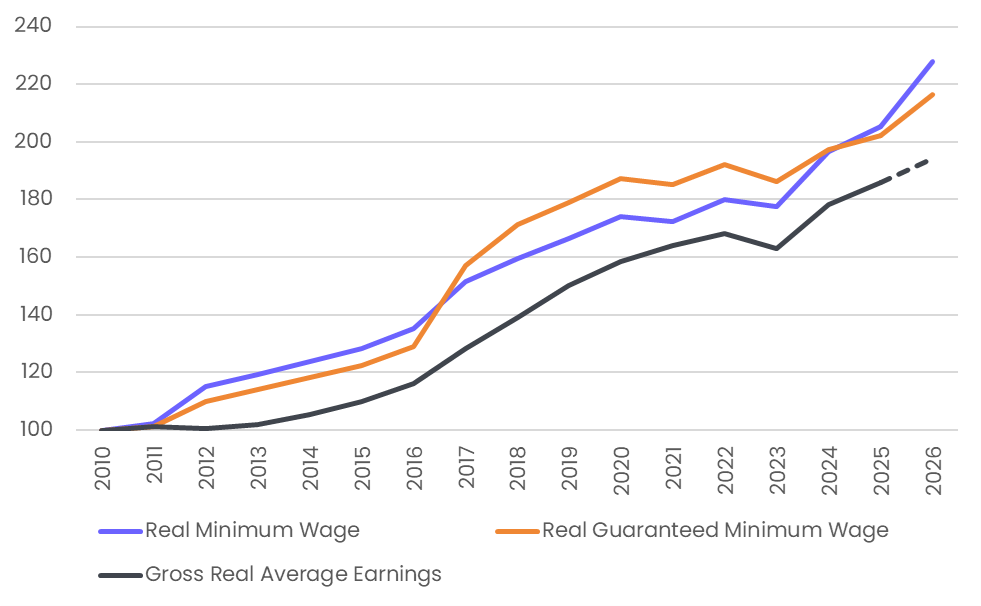
Changes in the real value of the minimum wage, the guaranteed minimum wage and the average wage, 2010-2026 (2010=100%, gross values)
Source: Central Statistical Office
Between 2010 and 2019, domestic wages were characterized by dynamic catching-up: the real value of the gross average wage increased by 55%, the minimum wage by 67%, and the guaranteed minimum wage (the minimum wage for positions requiring secondary education or vocational training) by nearly 79% compared to 2010. Subsequently, in the early 2020s, the unfavorable macroeconomic environment – the coronavirus crisis, then geopolitical tensions and the inflationary shock – broke this trend: the growth of real wages slowed down significantly and the previously achieved level also decreased . A clear turning point emerged in 2024: alongside the decline in inflation, nominal wage increases again resulted in real wage growth, and this continued in 2025, but at a slower pace. From January 1, 2026, the minimum wage increased by 11% to HUF 322,800, and the guaranteed minimum wage increased by 7% to HUF 373,200.
Overall, this year, due to the expected increase in real earnings of around 4%, the real value of the gross average wage will be 95% higher than in 2010, while the real value of the minimum wage (+130%) and the guaranteed minimum wage (+115%) will increase faster, thus converging wage levels. The rapidly increasing minimum wage and guaranteed minimum wage increase consumption in the lowest wage bands, but this requires substantial adaptation on the part of companies. Therefore, the budgetary and employment impact ultimately depends on how well companies can manage the higher wage costs. In the current economic environment, this often represents a difficulty, which reduces the positive effects of wage increases through employment reduction (layoffs). Although the labor market is still tight, those working on the minimum wage and the guaranteed minimum wage remain more vulnerable and have difficulty finding jobs due to skills and geography. The question is therefore not whether it makes sense to increase both minimum wages, but rather how much of an increase would remain economically sustainable.
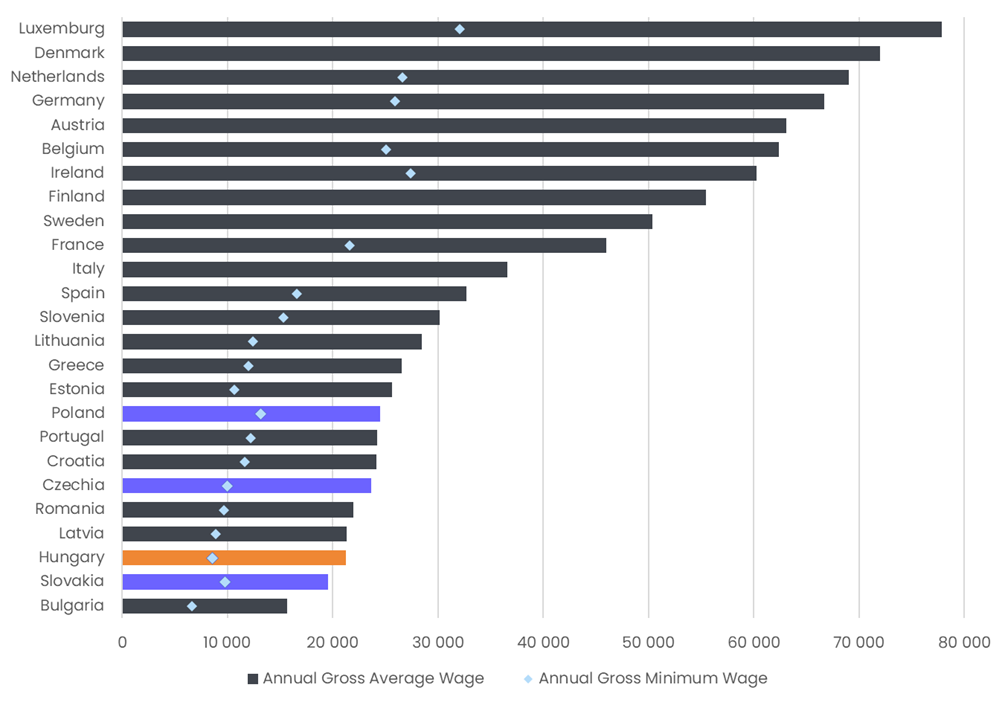
It is worth comparing the domestic situation with the Central European and EU labor markets. Based on 2025 data, the Hungarian annual gross average wage was 21.3 thousand euros, which put us ahead of Slovakia, but behind the Czech Republic and Poland. Hungary’s level of minimum wage is second, while the average wage level is the 3rd lowest in the EU. This means that the Hungarian wage level lags significantly behind EU countries, meaning there is room for catching up.
Annual gross average wage and minimum wage in EU countries, 2025 (euro)
Overall, the real wage increase between 2010 and 2026 was not sufficient to achieve wage convergence, but there are significant obstacles to further progress. The main question for the next period will therefore be whether wage increases can support wage convergence without overburdening companies and jeopardising employment stability. The solution is to increase corporate productivity , as this will provide the basis for wage levels to rise faster than the EU average.