

In its latest survey, conducted in January 2026, GKI Economic Research surveyed companies with more than five employees, including questions on their wage-increase intentions for 2025. A total of 850 responses were received to the wage-related question.
On average, the surveyed firms plan to raise wages by 6.3% this year (6% when weighted by headcount[1]), which – against expected inflation of around 4% – implies an average real-wage increase of 2% within this group. This is somewhat lower than last year’s plans (6.6%), although inflation expectations at the time were also slightly lower.
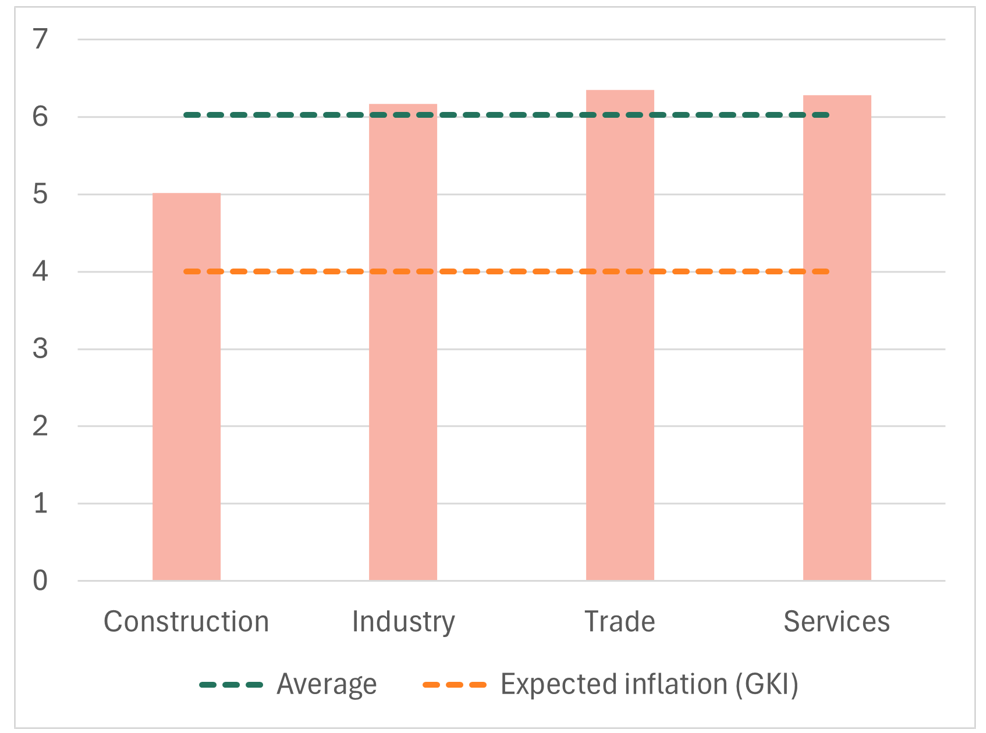
Construction firms again plan more modest increases this year, of around 5%. By contrast, employers in industry, trade and services are anticipating average rises slightly above 6%.
Wage-increase intentions among Hungarian firms, by sector, 2026 (%)
Source: GKI Survey, GKI Forecast
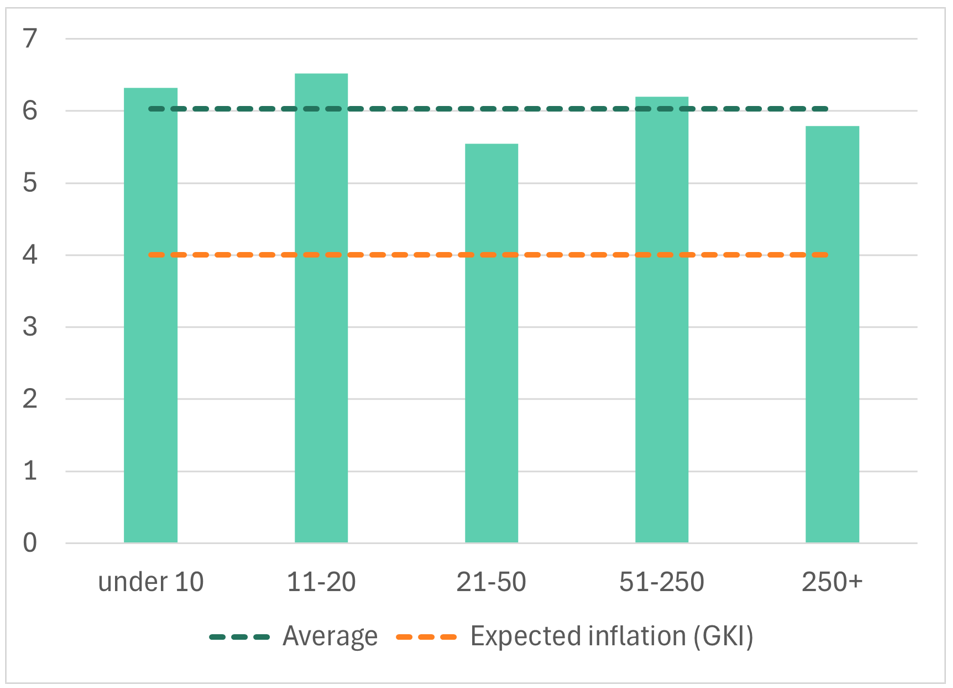
By company size, just as last year, there are no striking differences in wage-increase intentions this year. Although wages are typically higher at multinationals, the relative advantage over SMEs is not expected to widen further this year.
Wage-increase intentions among Hungarian firms,
by number of employees, 2026 (%)
Source: GKI Survey, GKI Forecast
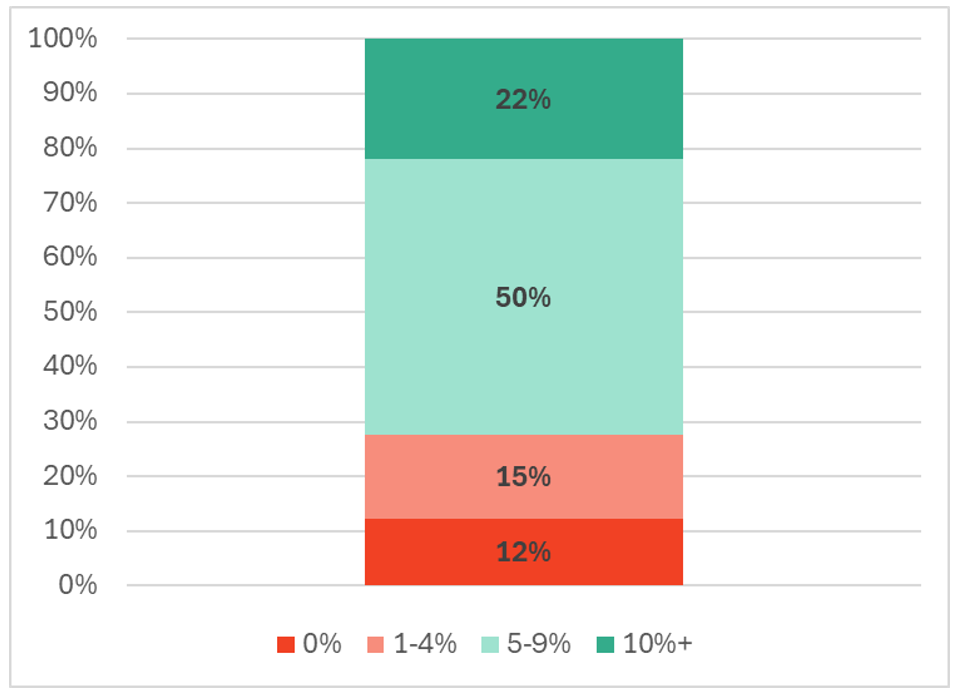
Twelve per cent of the surveyed firms do not plan any wage increase at all, while a further 15% expect rises of less than 5%. Half of the companies plan increases of 5–9%, and 22% are budgeting for 10% or more.
Wage-increase intentions of companies, % distribution
Source: GKI Survey
Among micro-enterprises, the share of firms planning no increase at all, as well as those aiming for rises above 10%, is higher. By contrast, larger companies report more balanced figures, typically planning increases of 5–9%. This illustrates that micro-enterprises may be either conservative or generous depending on business prospects, whereas the largest firms raise wages in line with market standards.
Overall – assuming 4% inflation this year – 18% of employees at the surveyed firms could see a real-wage decline if current plans are implemented, while three-quarters would experience a real increase. Around 7% can expect real-wage stagnation. These proportions are broadly in line with the 2025 figures from the Hungarian Central Statistical Office. The picture is slightly nuanced by full personal income-tax exemptions for mothers of three children, and partial exemptions for mothers of two; in these cases, net pay rises even without a wage increase. Conversely, employees turning 25 this year will see a fall in net pay in the absence of specific measures.
Wage-increase intentions are slightly stronger in manual roles (6.1%) than in white-collar positions (5.7%). This is likely due to the 11% rise in the minimum wage and the 7% increase in the guaranteed minimum wage, which primarily affect blue-collar workers. Moreover, the regulations have a knock-on effect on lower-income categories, as employers also tend to grant larger increases to those earning above the minimum to avoid wage pressure.
As expected, larger wage increases are planned by companies that are expanding their workforce, those whose business conditions improved over the past three months, and those that intend to raise prices this year. The dominant, fast-growing firms can both afford more generous increases and need them to sustain their market expansion.
[1] In the remainder of the article, results weighted by headcount are presented. The findings therefore reflect wage-increase intentions as they apply to the average employee (rather than the average firm).