

The latest Eurostat data shows that in a European perspective, our country had the third highest annual average inflation in 2025, equal to Croatia.
Consumer price index of 35 European countries in 2025 (percentage)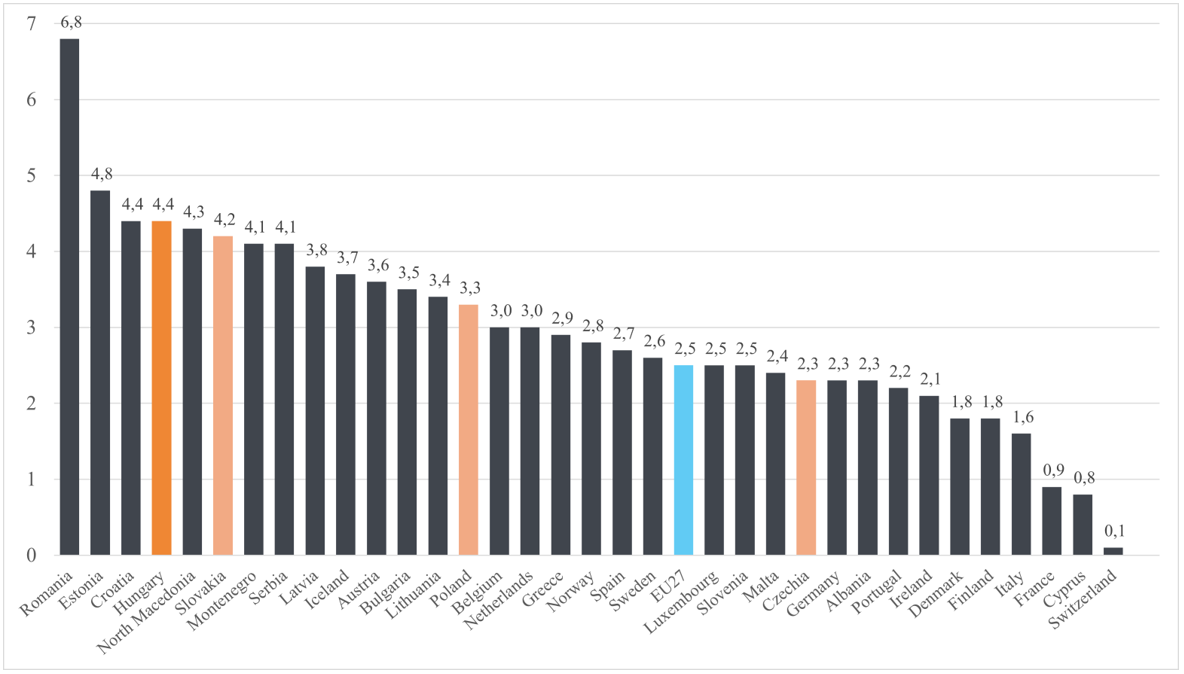
Source: Eurostat
Among the Visegrád countries, Hungary had the highest rate of currency depreciation, closely followed by Slovakia, which is struggling with similar macroeconomic challenges, while Poland is in the middle of the European field. The Czech Republic is the only one of the four that has managed to keep its inflation below the EU average. In 2025, the eurozone inflation rate was 2.1%, and the European Central Bank forecasts 1.9% for 2026. This means that the average data for the eurozone is in line with the ECB’s inflation target, although inflation is much higher than the 2% target in several Eastern European member states, including the aforementioned Slovakia and Croatia, as well as in the Baltic countries.
Domestic inflation has gradually declined since the fall of 2025, but the uncertain geopolitical situation, the unpredictable customs environment and the surge in energy prices can be assessed as significant upside risks. In addition, the freeze on fuel prices until May 1 will contribute significantly to the stabilization of the price index. The National Bank According to the statement, the domestic inflation target can be sustainably achieved by the second half of 2027, which is in line with GKI’s forecast. We expect inflation of 4%, close to the upper limit of the tolerance band, for 2026, and then in 2027 the increase in the price level may already be within the tolerance band.