

On Tuesday, at its base-rate setting meeting, the Monetary Council kept the base rate at 6,25%, as expected by analysts. Looking at the inflation data, this may come as a surprise: the era of drastic price increases in 2022-2023 is over, even if consumers’ inflation perceptions remain high .
Compared to 2024, the rate of price increase was higher in 2025 (+3.7% and +4.4%), thus registering the 3rd highest values in Europe last year . At the same time, by the end of 2025, the consumer price index began to moderate, and the price increases at the beginning of 2026 also remained modest, so after a long time, the rate of domestic price increase was finally slightly below the average of our regional competitors.
Consumer price index of the V4 countries and the Eurozone (compared to the same period of the previous year, %)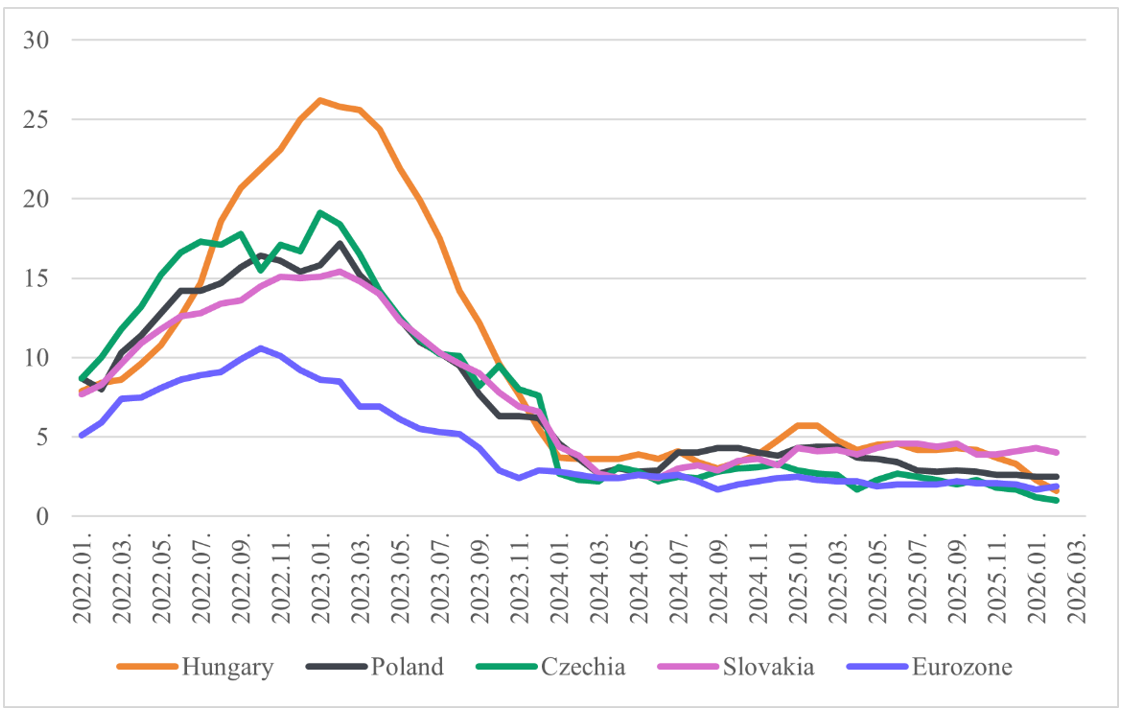 Source: Eurostat
The central bank’s new leadership’s strict monetary policy played a major role in the favorable price development. The high base rate supported the forint, and the strengthening domestic currency moderated import prices. The high interest rates also shifted market participants from consumption to savings (even if the impact was more moderate in our country due to interest-subsidized loans), thus reducing demand-driven price increases.
The consolidation of international energy prices and the decline in EU producer prices reduced inflationary pressures until early March. In addition, administrative measures by the government (e.g. margins freeze, “voluntary” commitments by the telecommunications, banking and insurance sectors) also curbed the pace of price increases in the short term (while distorting the logic of the market economy).
Base rate developments in our region and the Eurozone (%)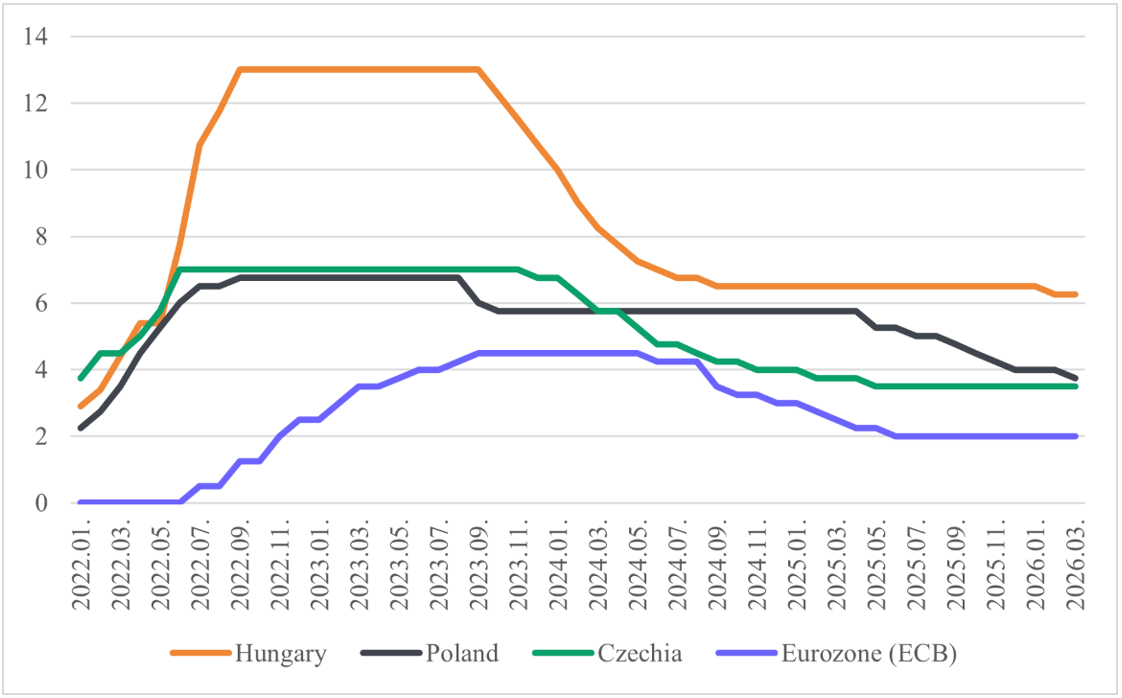 Source: Bank for International Settlements
In February, in light of the favourable data, the Monetary Council saw the time as ripe for an interest rate cut. The forint exchange rate did not change significantly on the news of the easing, which is a sign that the market was expecting the decision. After the interest rate cut, analysts speculated whether the Hungarian base rate – which is quite high by regional standards – could continue to be reduced in March.
Cautious optimism was overshadowed by the Iranian conflict: the forint became volatile and weakened, while international energy prices soared. The situation in the Middle East remains unresolved, increasing uncertainty and inflation risks, significantly limiting the room for manoeuvre of monetary policy.