

According to a survey by GKI Economic Research Ltd. – conducted with the support and methodology of the EU – the consumer confidence index increased slightly in March, while the business sector’s prospects deteriorated slightly compared to February. Thus, the summary indicator of expectations, the GKI economic sentiment index, decreased minimally. The willingness of enterprises to employ practically did not change, and the outlook for the expected development of sales prices increased slightly. The responding companies felt that the business environment was less predictable in the third month of this year than in February.
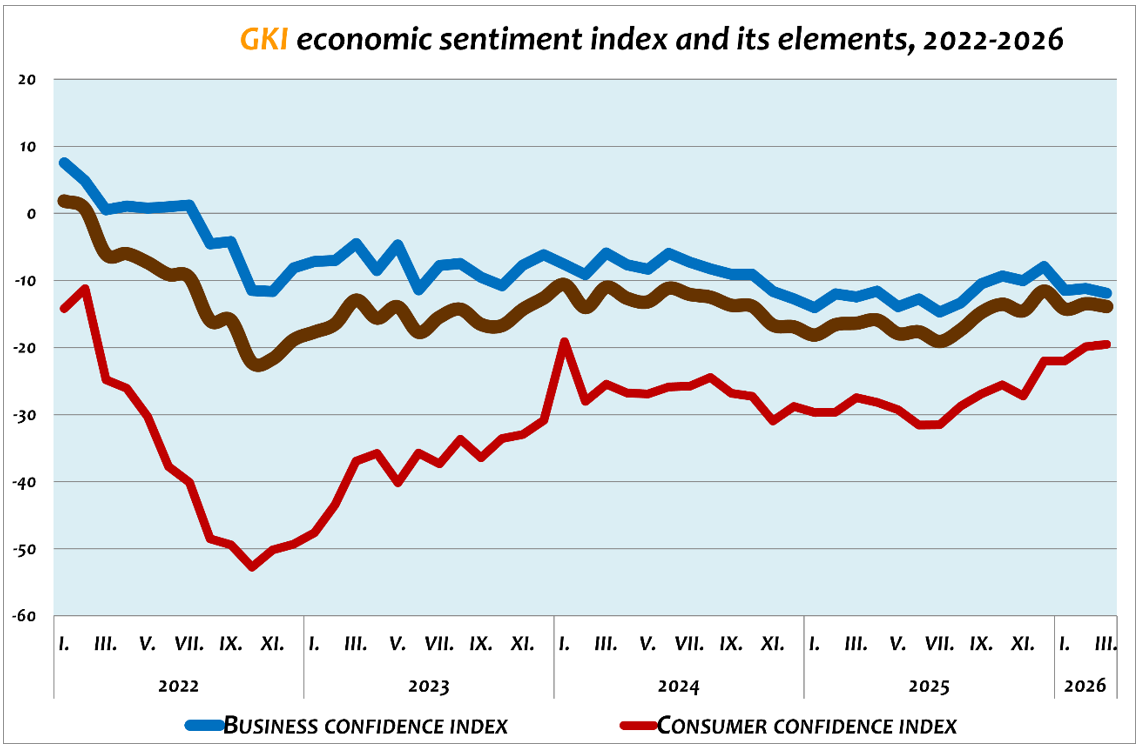
The GKI business confidence index decreased slightly in March compared to the previous month. The industrial confidence index decreased by 2 points, and the construction index by 4 points. At the same time, the trade and service sector indices increased by 2 points each. Regarding the prospects for the near future, the construction industry remains the least optimistic, while business services are the most optimistic sector.
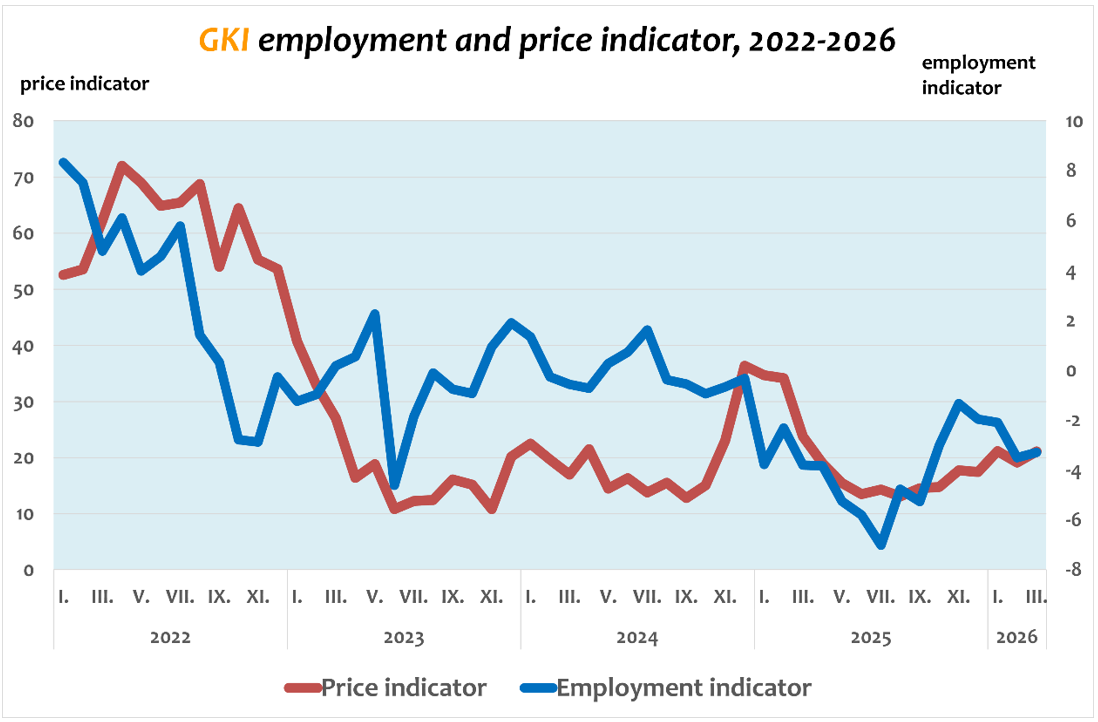
The employment indicator, which indicates the aggregated staffing expectations of enterprises, remained essentially unchanged in the third month of 2026 compared to February. In the next three months, 10% of enterprises are preparing to increase their staff, while 11% would reduce it. In the construction industry and trade, those seeking to reduce their staff are in the majority compared to those planning to expand, while in the industry and services sector it’s the other way around.
the business environment deteriorated in March, following February . With the exception of business services, respondents in all sectors felt the environment was less predictable than in February.
The price indicator , which shows the expected development of companies’ selling prices over the next three months, was at a ten-month high in January, fell slightly in February, and then returned to its January level in March . In the next three months, 30% of companies plan to increase prices, while 7% are preparing to reduce prices .
The GKI consumer confidence index jumped from the range between (-25) and (-32) points typical of the past two years to (-22) points in December, stagnated in January, and then rose above (-20) in February-March . In the current month, the population assessed their financial situation for the past 12 months as significantly improving compared to the previous month. In addition, they assessed their financial outlook for the next 12 months as moderate, and the country’s economic situation for the next 12 months as slightly more favorable than in February. However, the perception of having their own money to spend on high-value consumer goods deteriorated. Inflation expectations eased further, while the outlook for the expected development of the number of unemployed people deteriorated slightly, similar to the previous month.
The data for the figures can be found in the attached Excel file.
Methodological explanation :
When calculating the economic sentiment index, GKI Economic Research Co. – in accordance with the methodology of the European Commission – takes into account the expectations of the business sector and the population (i.e. consumers): the GKI economic sentiment index is the weighted average of the consumer confidence index and the business confidence index. The GKI business confidence index is the weighted average of the industrial, commercial, construction and service confidence indices. The employment indicator is the difference between the proportion of companies planning to increase or reduce the number of employees in the next three months. The price indicator is the difference between the proportion of companies planning to increase or reduce sales prices in the next three months. The GKI consumer confidence index is the arithmetic average of the balance indicators calculated from the answers given to questions asking about the assessment of the financial situation of households in the past 12 months, the financial outlook for the next 12 months, the expected development of the country’s economic situation, and the outlook for the purchase of durable consumer goods. The GKI publishes seasonally adjusted data , meaning that it uses the appropriate mathematical method to filter out differences caused by seasonal effects – such as higher demand before Christmas, lower production due to summer holidays.
Download exclusive detailed analysis Download background data