
Due to the conflict in Iran, domestic fuel prices, which had been falling for a year, have rebounded again, although the protected price temporarily stopped the increase. However, due to fuel reserves falling to a historic low, it seems that sooner or later we will not be able to stop market prices from prevailing at the border this time either. The GKI therefore examined the burden of rising fuel prices on domestic car users.
Since 2010, the price of fuel per liter has increased at a slightly lower rate than the consumer price index. Since most of the operating cost of a car is the money spent on fuel, fuel price developments are an important factor in terms of changes in the financial situation of car owners. To do this, it is worth examining how the price of fuel has changed compared to other consumer goods. According to our results, while the price index for gasoline was 76 percent higher in 2025 compared to 2010, and the price of diesel increased by 88 percent, inflation amounted to 93% cumulatively.
Fuel price index and consumer price index (2010 = 100%)
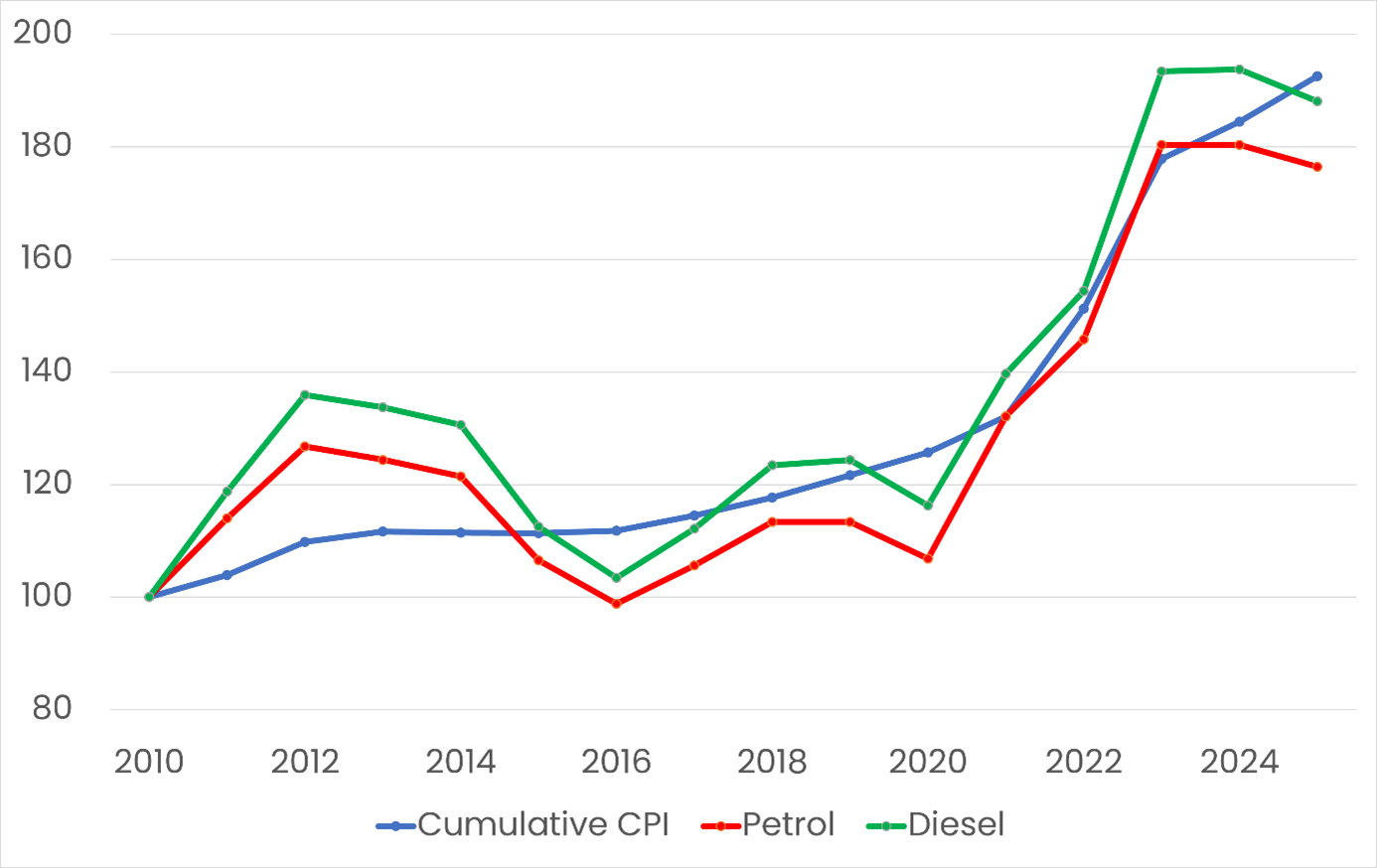
Source: KSH: fuel prices , consumer price index
From an affordability perspective, it is unfavorable that the weight of fuels in the consumer basket has increased. While it was 5.7% in 2010, its weight has increased to 7.3% by 2025. Thus, the impact of fuel prices on the consumer price index has become greater. Therefore, if fuel prices were to jump as a result of external shocks similar to the current situation in Iran, it would have a stronger impact on the financial situation of households.
However, due to frequent domestic rule changes and large fluctuations in the forint exchange rate, the relationship between oil prices and domestic fuel prices has been weak in recent years. In addition to direct government price regulations, the dollar/forint cross exchange rate and changes in tax content have had a significant impact on fuel prices. A striking example of this is that domestic fuel prices increased between 2022-2025 despite falling oil prices calculated in dollars.
Development of domestic fuel prices and Brent prices (2004 = 100%)
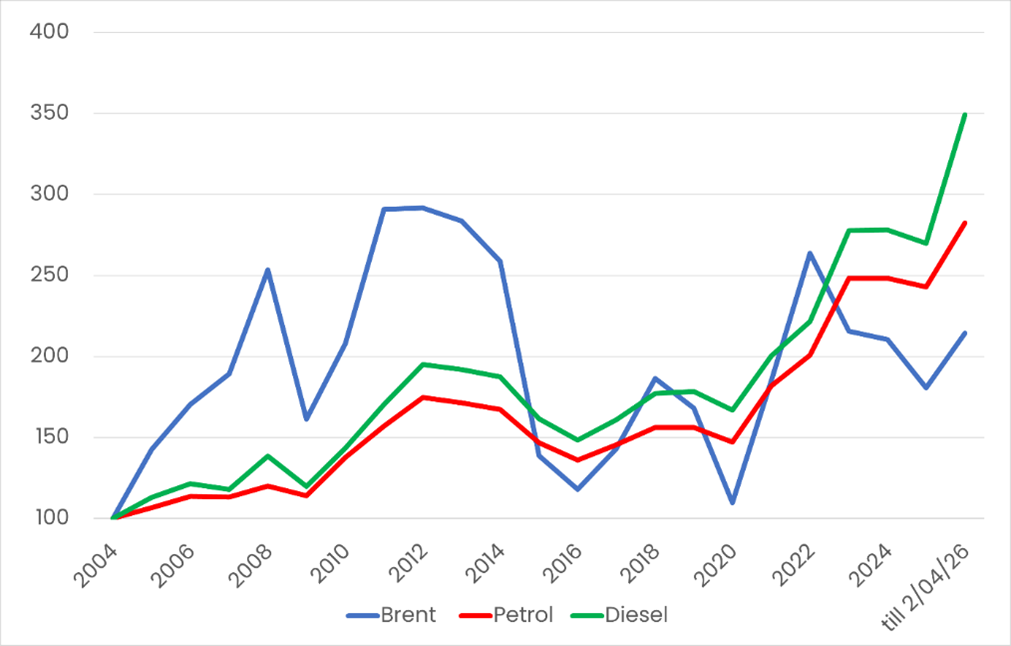
Source: KSH:annual average consumer price . Brent: annual stock exchange price
Comparing fuel prices to average monthly net wages: the picture became much more favorable by 2025 compared to 2010. In 2010, a monthly salary was enough for approximately 400 liters of vehicle fuel. The indicator reached its minimum in 2012, when a monthly salary was enough for just over 330 liters. Affordability then increased until 2021, and then the purchasable quantity decreased due to the surge in fuel prices (by almost 80 forints in one year). The government tried to manage this relative increase in price by imposing price caps on fuels, under which fuel prices were capped at 480 forints at the end of 2021 and in 2022. However, this solution was discontinued due to a severe fuel shortage, after which prices began to rise. However, due to the dynamic increase in average wages, the amount of fuel that could be purchased with the average salary increased to an average of 815 liters by 2025. So, we were able to buy more than twice as much fuel with our salary last year than 16 years ago.
How many liters of fuel could a worker with an average salary buy at most – market prices (liters)
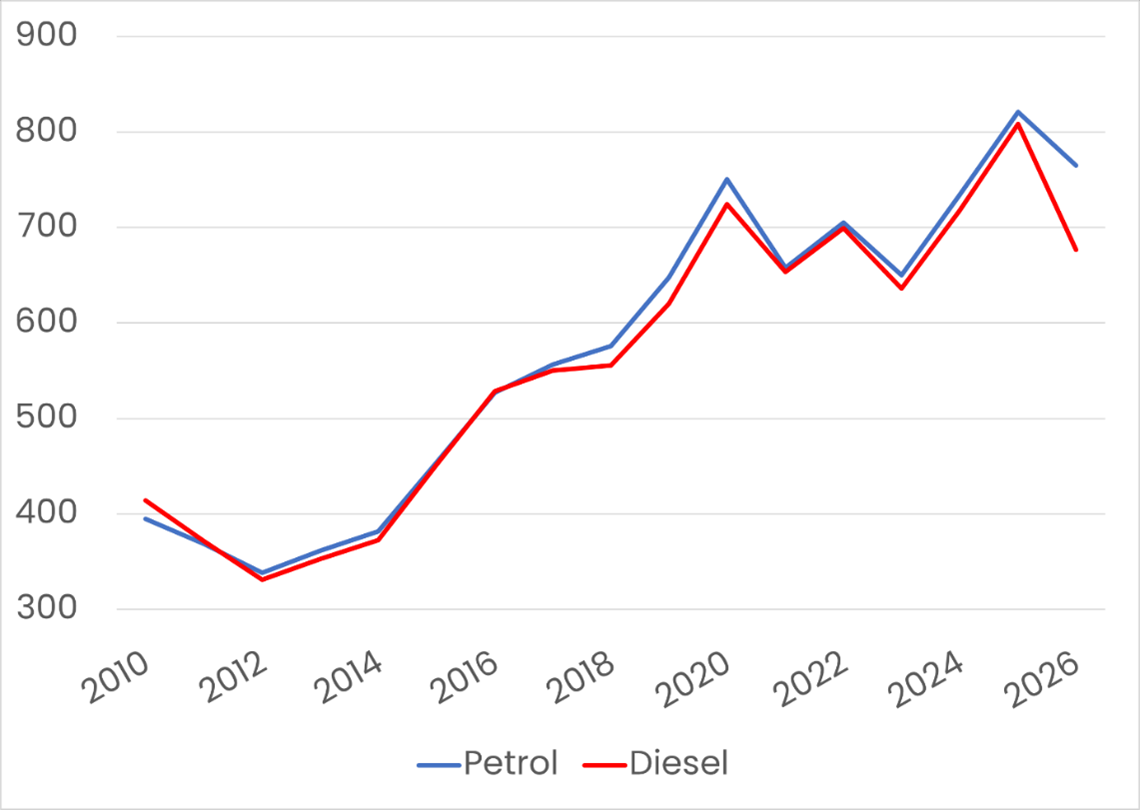
Source: Central Statistical Office: earnings , fuel prices
In March 2026, after the outbreak of the Middle East conflict, the Hungarian government reached for the price-caps again – fixing it at 595 and 615 HUF/liter respectively. Until the price caps are maintained – which the recently elected legislation has promised to do – fuel affordability will continue to improve due to rising wages. As a result of the new, fixed prices, the amount that can be purchased with a regular average monthly salary has increased to 886 liters of gasoline and 857 liters of diesel.
If market prices prevail, however, the burden on motorists would jump to the level of years ago. By the end of April, the stocks of fuels produced from cheap oil are expected to run out. Therefore, they will have to be replenished with fuels made from more expensive oil, and the increasing costs will have to be borne by one of the actors (e.g. MOL or, ultimately, entrepreneurs and the population through the state budget). Until the price cap is abolished, which is expected to reduce the affordability of fuel prices again. If fuel were to be purchased at the current market price, the amount that can be purchased from the average salary would decrease to 765 liters of gasoline or 677 liters of diesel, respectively. This would mean that instead of the favorable trends of recent years, maintaining cars would once again represent a greater burden.