

In this series of articles by GKI Economic Research Co., we present the short- and long-term economic challenges facing the new Hungarian government. The first part of our series focuses on Hungary’s population decline.
From an economic perspective, demographic trends are vital, as they determine the size of the workforce, tax revenues, pension expenditures, and the future trajectory of healthcare spending.
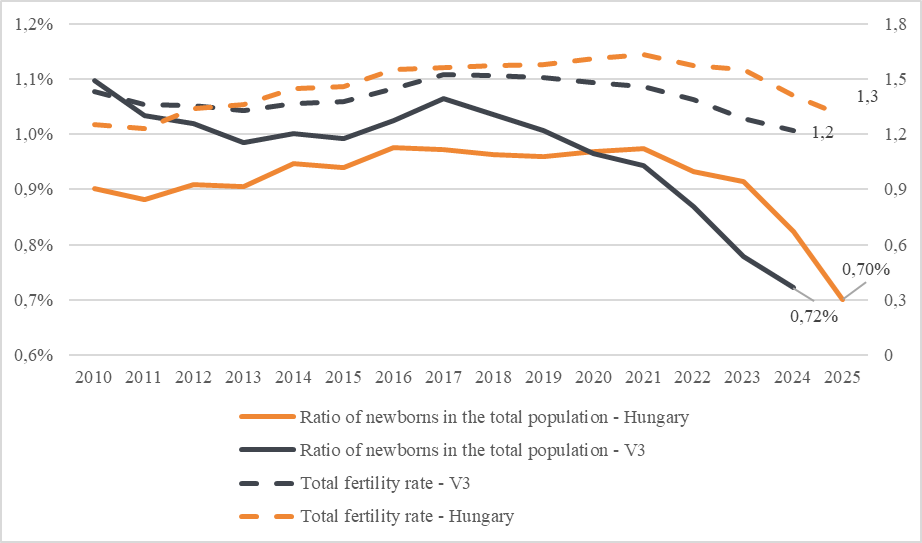
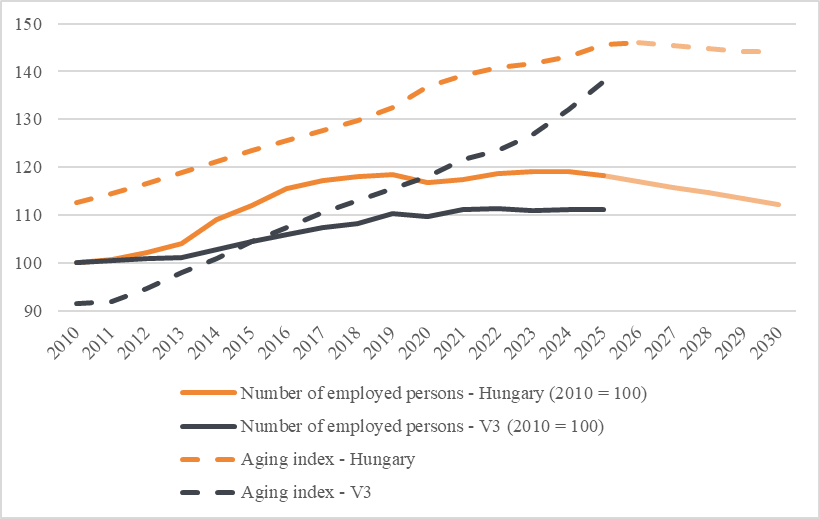
On average, a woman in Hungary gives birth to 1.3 children. While this is slightly better than the average of the V3 countries (Slovakia, Czechia, Poland), it remains significantly below the 2.1 replacement rate required to maintain a stable population. Consequently, Hungary’s population shrinks year after year, and the proportion of newborns within the total population has also begun to decline recently. This process started 4–5 years later in Hungary than in the V3, indicating an acceleration of population decline and aging. Hungary has an exceptionally high aging index of 147, meaning there are 147 people over the age of 65 for every 100 people under the age of 14.
According to data from the HCSO (KSH), the shrinking population is accompanied by a decrease in employment: in the first quarter of 2026, the number of employees fell by 65,000 compared to the same period of the previous year. We expect the number of employed persons to drop to 4.388 million (-5.2%) by 2030 compared to 2025, due to demographic reasons. Even in the short term, this results in lower revenues and significantly higher expenditures for the state budget. While the narrowing labor supply strengthens workers’ bargaining power and boosts wage growth, it presents significant cost pressures and recruitment difficulties for companies. In contrast, the rise of artificial intelligence and automation triggers opposing trends; however, the final outcome and precise scale of these two conflicting forces remain uncertain for now.
Between 2026 and 2030, budget revenues are expected to drop by a total of 680 billion HUF (at current prices) due to lower employment-related taxes and contributions, as well as a decline in VAT revenues. Meanwhile, pension expenditures are rising: demographic changes are projected to increase pension payouts by 230 billion HUF under the current system (at 2025 prices). Should further welfare measures be implemented, these costs will rise even higher.
The ratio of newborns to the total population (left axis) and the total fertility rate (right axis) in Hungary and the V3 countries[1] (2010–2025)
Source: Eurostat
The aging index (number of people over 65 per 100 people under 14) and the trend in the number of employees (2010 = 100)
Source: Eurostat, HCSO (KSH), 2026–30: GKI estimate
Since 2010, migration flows have intensified in both directions; however, the dynamics of immigration[2] have consistently managed to offset emigration. As a result, the net migration balance has been positive every year, contributing an average annual surplus of nearly 18,000 people to the population. In the coming years, the population-boosting effect of net migration may weaken, as immigration largely consists of guest workers whose numbers the new government intends to reduce.
Overall, in line with regional trends, no turnaround in demographic processes is expected in Hungary; in fact, unfavorable indicators foreshadow further economic hardships. Since these trends cannot be reversed in the short term, the focus should be shifted toward managing demographic impacts and adaptation.
[1] V3: The average of Slovakia, the Czech Republic, and Poland
[2] Persons residing in Hungary for at least one year (including guest workers and a portion of Ukrainian refugees).